
Year of the Tangram
April
It is in the floral heaviness of late-spring that his mother comes home and hands him the present. It fits well in the palms of his hands, neither too heavy nor too light. Perfectly square, perhaps—and later confirmed to be exactly—five inches wide by five inches tall, and a little less than an inch in depth, like some great Brobdingnagian pixel coaxed out of a computer screen and into his hands, or the world’s single thickest piece of origami paper.
Certainly, the present will be educational as it is neither his birthday nor a holiday, only a sunshiny afternoon in the lateness of April. Even on those occasions upon which his mother normally gives him gifts, she gifts him only items that she thinks might encourage and stimulate him intellectually and socially. Beyond that, it is difficult to say.
He hopes, as he always hopes, that his present is a book.
The boy turns the present appreciatively for a moment, giving a small, practiced smile out of politeness. His mother loves this smile.
His mother wraps presents better than anyone he knows. She has the superpower of knowing exactly how much paper and tape it will take to unmake any object, to sanitize it into a precise, mysterious lump.
The paper concealing the square is green and black, covered with little dinosaurs in party hats, left over from his last birthday and the birthday before it.
“Go on then, sweet pea, open it,” she says, her voice trembling under the weight of her pride.
The single crescent nail of his left pointer finger that he keeps long for just such a purpose slides smoothly under the little rectangle of tape securing the package.
The boy has the superpower of opening gifts without disturbing the paper. Other children rip and destroy, but not her sweet pea, her pumpkin, her plum, her peach.
He is a veritable garden of love that blooms and produces in all seasons in his mother’s eyes and the rows in which he finds himself planted are always neat, precise rows. There is no room for the wild selfhood of unpruned greenery in his mother’s house.
Before he quite gets the gift open, he again hopes it is a book. Failing that, a picture or diagram for his bedroom walls. It is neither.

The present is only seven thick shards of plastic, arranged into a disgusting, broken yellow square, laid flat in a frame. Bile rises in his throat, and his young heart races as a wave of terror encompasses his being.
A few facts now, about our protagonist. He is eight years old and tall for his age, but under-muscled and too awkward for the sports in which his height might serve as an advantage. He is quiet, cautious, and polite to a fault. He loves books more than anything else in the whole world, including his mother, a fact which she has noticed and ignored for as long as either of them can remember. He is his mother’s closest friend. She despises him and he knows it. She does not.
His mother has already unknowingly instilled in him her disorder, her hatred of the untidy. He is the smartest child in his class. He struggles socially. He is, despite his mother’s best efforts, a creative, though not in the traditional and encouraged ways of being a creative, which might explain his mother’s reluctance to spur this side of her son. He cries more than most boys his age and even some of the girls in his class are offput by the frequency and ease with which he cries.
He loves puzzles and wordplay and codes. He keeps two window boxes of flowers outside his bedroom and a red fighting fish on the desk where he does his homework. The fish is called D’Artagnan. The boy hates, more than anything, the sight of the color yellow.
The disgusting, broken square confronts him. To soothe himself, he begins to externally rock and internally rhyme. Weight shifting between the balls and heels of his feet, he lets out an imperceptible keen. The gift is pus yellow, bus yellow. The gift is there, square. A gift, a rift, between he and his mother.
Swarming in and out of his eyes, the yellow affront takes up all the space in the universe and he, so small in its shadow, can only trace the sharp angles at which the present is broken with his one sharp nail. There are no words to encapsulate how terrible the toy is.
“It’s a tangram,” his mother explains. “A puzzle, pumpkin. You like puzzles.” This is a grotesque understatement. The boy loves puzzles. He does not love the tangram.
The tacky plastic of the tangram catches the light in the ceiling fan as he shrieks and dashes it wordlessly against the floor. The square’s seven shards shoot out across the white tiled living room.
He retreats to his own room, to his bed, and hides under the covers, not coming out for anything until the next morning, when he rises with his alarm clock, readies himself for school, and ignores the re-formed tangram on his desk as he feeds his fish. His mother does not bring the tangram up at all.
May
At first, the compromise had been only no kindergarten. Everything had seemed very reasonable when she was only set to keep her little boy home for kindergarten. He would get some time to catch up socially, and she would get some extra time to bond with her child.
And after all, they’d tried preschool, found it a miserable failure on all counts. Her intelligent son, usually unable to be moved to greater emotions than mawkish and bookish, had come home every day of that first and only week an unrepentant, energetic little ball of fury. He had hit and screamed and even bit her between his tears. The good little boy his mother had loved was gone, changed to some unhappy brat.
So she kept him home, for preschool and then for kindergarten, then the first grade, then the second. But last fall, she had needed to go back to work and so she had sent him into the third grade, and though he was still, in many ways, an easier and quieter child than her friends’ children, sending him to school had shifted their relationship into unfamiliar spaces and made her son a stranger to her.
Yes, he still sat as close to her as he could, both at home and away. Yes, he still ate his vegetables, folded his laundry, minded his manners in public places. But something was wrong.
While the core goodness of her son remained, the year away had done irreparable damage.
The soft-bodied solo games of hospital that he had played at his mother’s feet took on a sinister cast. Why did Fuffy Bunny, an old stuffed animal from some bygone Easter that her son was irrevocably attached to, need so much emergency surgery? Wasn’t she careful? Wasn’t he careful with his friend of many years?
On the last day of school, as the boy sulked in the back row of her ever-hopeful minivan, still waiting on child two, three, four, etc., she considered asking him if he’d like to return to being homeschooled in the fall. Considered it for a long moment, and then cast the thought aside when, without warning, he looked up at her and said, “I still hate the stupid tangram.”
She decided then that the less time this version of the boy spent at home, the better. Perhaps school was teaching him to advocate for himself. Perhaps she was tired of being advocated against.
June
He still hates the stupid tangram. It is his birthday, and the sight of his gift at the kitchen table and the omnipresent dinosaur paper concealing it only makes him furious.
No one comes to his party. He mopes. He goes to his room to play with D’Artagnan and Fuffy Bunny and to avoid listening in on his mother’s phone calls with her friends, and with the mothers of his classmates, where she somehow ends up apologizing to them for the fact none of them brought their children to his party.
The tangram has a fine sheet of dust over its surface. It is the only dirty thing in the room.
His father comes home late from work and forgets to say anything at all until his mother points and prompts towards the dining room table, on which the still-wrapped gift, a card, an enormous chocolate cake, and a delivery pizza (cold thanks to his father’s lateness) wait.
“Happy birthday, Kai,” his father says sheepishly.
The boy says nothing.
His mother laughs her uncomfortable laugh and starts bustling in the kitchen for plates, even though the boy has already set the table.
They eat in relative silence. Sometimes his father asks his mother something. Sometimes she replies. Sometimes, independent of adult conversation, the boy offers up an unprompted fact.
“More than two thirds of the world’s water is stored in glaciers,” or “roses don’t actually have thorns, they have prickles.”
They finish the cold pizza, make a dent in the cake, and as a treat they watch Jurassic Park.
When the boy opens his gift this time, it really is a book, a nonfiction compendium of mummies with glossy, full color images of corpses desiccated by cold and heat and salt and peat.
The boy smiles up at his mother, his real smile this time. He has a gap-toothed, face-splitting smile when he isn’t forcing it down. His mother frowns.
“This is super-terrific. Awesome. Thank you,” he holds his hand up for a high five.
Belatedly, she returns the gesture. There’s a soft smack when their hands connect. “Anything for you, plum.”
Anything but the removal of the tangram.
July
It was too hot for anything to happen in July. The boy still hated the tangram.
August
When the boy gets home from school, he is to sit at his desk and do his homework before he may read or play. Unfortunately, the tangram’s infernal presence makes his desk uninhabitable, and nothing seems to help.
As a first day of school present, his mother gives him another gift.
The gift is good because it is a book. The gift is bad because it is a book of silhouetted, blocky figures meant to be made with the tangram.
His favorite is number twenty-one, “leaping rabbit.” He does not know how to make “leaping rabbit” yet.
His least favorite is number six, “man falling.” He has figured out “man falling,” though not on his own.
The way he figures out “man falling” is this. He wakes up earlier than his mother. Considers and then discards the idea of making his own breakfast, and neglects to pack his own lunch. He then returns to his room to read before she drives him to school.
From his bed, Fuffy Bunny watches with her usual vacancy.
There isn’t anything new to read, and so he picks up the tangram, still there, still square. Turns it once, twice, three times in his hands.
Every angle reveals another sharp place, another new hurt the tangram might inflict. With a small noise of disgust and Fuffy Bunny’s approval, he drops the tangram back onto his desk. The pieces fall out like this:
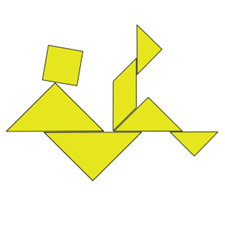
He recognizes at once the figure of “man falling,” but he still grabs the book of unsolved tangrams from his bookshelf and checks to be certain.
“How’d you end up doing that on your own, huh?” he ponders, his wonder outweighing his disgust.
Then, from everywhere and nowhere, the gelid voice of the tangram man, “You do most things on your own; why should I behave any differently?”
It should be upsetting, really, to be spoken to by seven ugly pieces of plastic, but it isn’t. Only curious. The man’s question leaves the boy with a lot to think about, and so he does.
He spends the whole rest of the day thinking but still doesn’t have a proper answer by the time he gets home. When he enters his room, the tangram is back in its square like nothing happened.
So, he now plays with the tangram some days before school, puts it back into “man falling,” or else drops it gently on the floor, the desk, the nightstand. But, if the tangram man has more to say or do, it—for the time being—stays silent.
September
She noticed he had begun to play with the tangram. Half of her was angry it had taken so long but the other half was relieved, grateful even, that the tempest had passed.
It had not been an idea she had come to organically, the tangram. She had read on a mommy-blog, or else heard on a podcast, or watched on the television, that a tangram might help her and her son in some vague way. For all that she couldn’t remember the origin of the advice, she remembered one key phrase. Some expert or another had called the tangram “an exercise in empathy,” and she had liked that.
Her son had both too much and too little empathy. He cried more than she remembered crying as a child. He had learned to sew by age five to help his stuffies when they were wounded, but he was often the one wounding them. He was incredibly sweet with his pet fish and had taught the little creature more tricks than most dogs knew, yet disliked most other animals.
He was blunt, often cold with her, and always so with his peers. He had a chilly, unflinching gaze, and stared at anyone and everyone in public for the smallest of reasons, but could never seem to look her in the eye.
So yes, her son undoubtedly had empathy, but the idea of his empathy getting some exercise gave their future a novel, hopeful cast. And the tangram was working, wasn’t it? It must be.
After all, even the terrible day she had first given him the puzzle, after he had thrown it to the floor and gone to his room, and after she had gone into hers with a top-heavy glass of wine and left the puzzle scattered on the living room floor, he must have returned, picked it up, and put it back together, because when she emerged the next morning and took him to school there it was, on his desk. Like it had always been there. Like it belonged there.
October
It is Halloween, and the boy is the wrong kind of mummy. His costume is a sloppy array of loose quilting scraps, strips of old towels, and cream-colored ace bandages pinned to an off-white sweater and khaki slacks, finished with a paper mask that his mother printed off the internet.
She brings it to him while he is sitting at his desk, spinning the tangram in its case like a top. No matter which way he turns it, the man inside stays silent.
“I said an ice mummy, like from the Franklin expedition. Here, look,” he shoves a book in her face. There is a double-page, full color photograph of the frozen corpse of a young man.
The mummy’s nose is blackened with frost-bite, his lips curled back into an unwilling sneer. The corpse’s jaw is affixed to the head by a tightly wound scarf. All of its yellow teeth protrude cartoonishly from the grimacing mouth. It is, perhaps, the most unsettling photograph his mother has ever seen.
She feels ill. “Why would you want to be dead, Kai? Everyone at school will think you’re a zombie or something. This is better, really. No one in your class will know what an ice mummy is.”
His lip quivers, and his eyes water as he very softly says, “I’d know.” He fixes her with a horrible, heart-breaking look, and then returns to his tangram without further comment. The topic is dropped there.
He decides to make the best of what he has and wraps Fuffy Bunny in toilet paper, bringing her along to school. If pharaohs got cats and dogs and wives, then he could be forgiven for bringing a rabbit into the afterlife. He is dropped off at school peacefully, despite the near incident over his costume.
His mother gets the call to pick him up early just as she sits down to lunch.
When she arrives, the already bedraggled mummy-suit is threadbare and bloodied, folded beside her son’s backpack at the front desk. She wonders what he’s wearing, if its textures are amplifying his issues. Before she meets with anyone, she must check on the boy.
Her son is in the back of the nurse’s office, the curtain drawn around him for privacy as he moans and growls to himself.
The nurse, sympathetic, already friendly with the boy and his mother, gives a hopeless shrug. “Someone took his rabbit, I think. I didn’t see the fight, but that’s what he’s been saying when I can get him to talk. If you want, you can leave him in here when you go see the principal.”
She does. As she walks away, she knows it’s the wrong choice, and makes it anyway. She catches a slight shift in the key of his crying, but it’s too late. She is already down the hall, in the office. She doesn’t have time to tend to him and save face.
She sits across the desk from the principal, a wealthier neighbor she’s never liked very much, as he explains the school’s no tolerance policy. Like she’s stupid. Like she hasn’t heard it all before.
“He didn’t start the fight.”
“It doesn’t matter. Kai escalated things. He could have gone to a teacher. He could have asked someone on yard duty for help.”
“He’s done all of that when he’s been hit before. He probably did it today. No one here takes his issues seriously. Do you know, last year, he was the only child in his class who didn’t receive any Valentines? The only one, in a class of thirty-two. And nobody cared. They took his bunny. It’s his best friend. It’s part of his costume.” Her appeals grow more impassioned as the principal remains impassive.
“Toys aren’t allowed in the classroom.”
“This wasn’t in the classroom, it was at recess, and I know that toys are allowed at recess. They took his bunny. They probably called him names. I wrote to you last year about the name-calling.”
The principal remains resolute. “They say they didn’t.”
His mother’s voice picks up the same helpless keen the boy is still emitting from the nurse’s office. “But they did. Search their bags. Make someone look outside.”
The principal says nothing.
His mother stands. Rises to her full height. Slips into her “good mom” costume with practiced ease, her glare as piercing and as hard as she knows how to make it.
Her hand hits the desk with a soft thud. “Then I’m saying he didn’t hit first. I’m saying he didn’t hit back. What happened was a group of playground bullies beat my autistic son and stole his bunny.
“I will take this to every news station, every paper, every forum that will hear me and then I’ll take it further. I’ll go before the schoolboard, before representatives. I will go to open houses in our neighborhood and tell prospective buyers what kind of school they’ll be sending their children to.
“I will say exactly which slur his third-grade teacher called him last year when expressing that he needed testing. I will then sue you personally—as well as the school—for damages, physical and emotional.
“Or, and this seems much simpler for the both of us, you can find me that fucking rabbit and this all goes away. Do I make myself clear?”
Sweating, the principal nods.
She leaves the room bristling as he hurriedly calls the boy’s teacher to begin a search for Fuffy Bunny. There’s a bounce behind each step as she returns to her son. She’s proud of what she’s done.
The boy is not. He looks up at her with wide, wet eyes from behind his crookedly hung glasses. His nose is dripping snot and blood onto the school’s shirt. He bares his teeth, smiling at her the way monkeys smile—a warning, before hiding his face in his scraped knees.
Even though he is too big and she is too small, the office staff are watching, and so she carries him back to the minivan. He whimpers, rubbing his wet face against her chest.
He asks if they can get cheeseburgers on the way home, so they get cheeseburgers. He cries while eating. She tries not to yell at him for disrupting both her day and her diet.
He perches on the side of the tub once they get home and allows her to clean his wounds, something he’d denied the nurse. He leans into each touch, receptive to her preening, but still, annoyingly, he cries.
He cries through two spooky movies while his mother tries to put together a substitute costume. No, he won’t be pirate. No, he won’t be an army guy. No to cowboy. No to vampire. At each failed suggestion, he retreats a little deeper into the cold well of self, and her frustration grows. His face is darkly bruised. His nose might be broken.
Finally, she leaves the room and returns with a silk scarf that belonged to her grandmother and one of the boy’s blue winter sweaters. She tosses them to him from several feet away.
“You can be an ice mummy, Kai.”
She accepts defeat and resigns herself to the fact he’ll probably want his cheeks hollowed and rouged with her makeup to complete his transformation, then realizes all the bruising will make this unnecessary.
He gives her the same unfocussed, wide-toothed stare of that horrible corpse before bursting into laughter and running to get changed.
November
It took the school longer than it should have to find Fuffy Bunny. She’d had to make more of an issue than should ever be made over a too-old stuffed rabbit, but eventually her son’s friend came home.
But while the little rabbit had been kidnapped, the boy’s love for his doll had shifted. She was still loved, certainly, still slept beside him on his pillow at night, but her presence in his games was severely diminished. The games themselves were diminished.
Gone was her little surgeon. Gone was her dissector of mummies. Only the tangram seemed to be able to hold the boy’s attention.
When she knit on the weekends and he sat beside her, he brought the tangram, not Fuffy Bunny. When they went to church, she would watch him trace lines into the backs of pews, making shapeless shapes. He had begun to ask her a lot of questions about the mechanics of the puzzle, questions about math that she did not know how to answer.
On Thanksgiving, on the ride to her parents’ house, he flipped quietly through the book of unsolved tangrams, and then his book of mummies, then back to the tangrams. When he thought she wasn’t looking, he took strange, coded notes in the margins of both books with a pencil.
Then they were at her parents’ house. The entire driveway and all her siblings’ cars were covered in a fine dusting of snow. There were icicles hanging from the eaves. As soon as they’d parked, the boy disappeared somewhere inside.
He showed his cousins a solved tangram that was supposed to be a man falling before they waved him off to play real games. He then showed his aunts and uncles and grandparents. He showed almost anyone and everyone the puzzle, asking them what they saw, what they heard, what they thought, ignoring the way they ignored him.
But he didn’t show his mother. And the only question he asked her once they’d arrived at her parents’ house was if she would pass the gravy, please. Whatever they were all supposed to be seeing, she didn’t get to see it.
December
These are some facts the boy has learned about the tangram man. He is writing the facts in the margins of his books, in code, but they are here, uncoded, for the progression of our story.
The tangram man doesn’t talk or otherwise make itself known to anyone but the boy. The tangram man is always in the tangram, whether it is a square, or a boat, or a person, or a shape, any shape at all. The tangram man can see and hear. The tangram man can move and manipulate itself but prefers not to be seen doing so. The tangram man answers most questions with questions.
It is snowing every day now.
In the snow, in the front yard, the boy draws larger tangrams. Fuffy Bunny and D’Artagnan watch from inside his room, peeking out over the tops of the dead window boxes.
He uses a yardstick and a compass to get all the angles exactly right. He starts with the original square, then “man falling,” and works his way through all the solved tangrams he knows.
He feels the man’s eyeless sight in every snowflake as he remembers the complex geometries of its forms. He thinks he hears its laughter in the crunch of ice beneath his boots.
Maybe the man is in every broken mirror, around every sharp corner. The man sweeps into the world through the fractured places, purposes unknown. Friend or foe, real or not-real. The boy wonders if there’s enough paper in the world to write down the things he doesn’t know about the tangram man.
The boy solves a tangram, scuffs it out, and tries again. He stays outside until his cheeks and hands are raw with wind and cold. As he works, the boy begins to pray.
He prays that he will successfully recreate the man on a larger scale and then someone else will notice what he notices. Someone else will take the burden of investigation from his lonely little shoulders and let him come in from the cold. Someone else will solve the mystery, once he can say what the mystery is. He prays to be seen, to be understood, to be loved.
But the only observers of his labors are a pet fish, a stuffed rabbit, and the tangram man itself, and so whatever the boy hopes to prove to the world disappears on the wind. It is lost in a snow drift or else pulled under a snowplow. It melts before his mother finally realizes how long he’s been outside and drags him in by the hood of his parka, tears frozen to his chaffed face.
January
She’d considered, over Christmas break, getting rid of the tangram. How she hated herself for this, continued to hate herself for it and all her annoyances with her son’s fixations, his interests, the way he would get stuck on the strangest things and build walls around himself with them.
There were his books, his codes, his dinosaurs. Flowers, specifically roses. Surgery, then autopsy, then mummies. Ice mummies. Ice, for Christ’s sake, and who’d ever heard of a little boy that loved ice? She’d tried explaining how it made her feel to her therapist once but left the appointment feeling less heard and less a mother.
Now, the tangram. He’d hated the tangram. For weeks it had been all he could talk about, his hatred of nothing more than seven pieces of plastic in a frame. It was irrational, and his irrationality beget hers.
To try and tear him away from the tangram, first, she gave him extra attention, more screen time, more visits to the library, but every bribe went unmentioned and unappreciated by the boy and so she tried the opposite.
She grew stricter, more precise. She made him fold and refold his laundry for five hours one night as he turned his t-shirts, which he usually hung, into little right triangles and squares and parallelograms.
When he brought papers home from school, the tangram was there too, doodled beside his history homework and his book reports. His grades in math, usually among his best, had begun slipping, as the only mathematics that held any interest were the sick geometry of the tangram. Seven shapes with the power to undo everything she had worked for. Seven shapes working as one.
She felt sick all the time now, and had been feeling progressively worse since late-November.
She had suspicions as to why that might be. Her anxiety, perhaps. She’d been anxious longer than she’d been a mother, and motherhood had only made anxiety worse.
Motherhood made everything worse.
Her symptoms were inconstant. One week she might wake up to find she had gained weight. The next week she might have lost it. She might be more tired one day, more high-strung the next. She might have aching knees, then aching ankles. Her body was becoming as strange and all-consuming to her as the tangram was to the boy.
She might, she realized, one night in the first deep freeze of the new year, have more than suspicions. She might have an answer as to why she woke up feeling nauseous every day—but this wasn’t the time to voice it, not yet.
February
He stays home for the class Valentine’s Day party, as much at his mother’s prompting as at his own. She has been cautious recently, working from home more and more. She is never late to pick him up, the way she sometimes used to be. The minivan opens up before he’s made it to the curb, closes before he’s buckled in.
His father has two-dozen roses delivered while his mother is on a conference call. Whether through an error on his father’s part or an error on the florist’s, they are white, not red.
The boy takes them into the kitchen and places them with their stems in a baking dish full of lukewarm water. He uses a stepladder to get down a vase, then washes it in the kitchen sink.
He fills the vase part-way with more warm water, gets a lemon from the bowl of citrus his mother keeps on the counter and sugar from the pantry. After slicing and juicing the lemon, he stirs in some sugar and some of the lemon’s juice. These things will help preserve the roses and let them bloom more fully.
He then gets the kitchen shears and begins to trim exactly one quarter inch off of every stem, at a forty-five-degree angle, before placing them into the half-filled vase. On the last rose, a raven flies into the kitchen window.
A thud like thunder echoes in the glass. The boy expects some mark or fracture from the bird’s misadventure, but there is none. The pane holds.
He leans over the sink to look out into the yard, but the bird is nowhere to be seen in the great white expanse of suburbia and so he returns to the roses, only to find that the shears must have slipped. He is bleeding into the baking dish that held the roses.
The shears have left a triangular flap of skin over his left index finger. He cuts the last rose less perfectly than the twenty-three before it and places it amongst its brethren.
After much deliberation, he still feeds the bloodied water from the baking dish to the roses.
By the time his mother gets off her call, he has cleaned his cut and put the roses on the dining room table. He retreats to his room without dinner and tucks himself into bed.
In the halfway space between wakefulness and dreams, he thinks he hears his father wonder at the florist having had red roses after all.
March
She was right. There were too many things to consider now for anything to happen in March.
April
It is a year to the day now since his mother brought home the tangram and with it, the tangram man. His parents are at an ultrasound appointment.
The boy is home, but not alone. He sits on the living room floor, Fuffy Bunny in his lap. The tangram man looms up at him from its square.
The boy asks, “How long is it going to be like this? Everyone overlooking me because I’m not the kind of person they want me to be.”
The tangram man slides out of the tangram and into the floor’s tiling. It is no longer cautious about being seen when it moves. Again and again, the living room tiles reform themselves into one glistening word: ETERNITY.
The boy considers this. His stomach growls and aches. He wishes someone had remembered to leave him dinner.
“I don’t want a little sister. Or, if I do, I want one that’s like me. They’ve already decided, somehow, that she’s not going to be like me. As if that’s something they can just decide. Nobody chooses this. It just is. I don’t even want it, some days, and it’s all I can be.
“I don’t want this little sister. I don’t want to be a big brother. I’m their boy, the boy.”
Loudly, then, comes the source-less voice of the tangram man, “You don’t have to be. There are choices you cannot make, most certainly, but there are many choices which you can. Of this I assure you.”
Inside, the boy shrinks and shivers. Outside, an unseasonably late snow begins to fall.
Though there are only the seven yellow tiles, somehow two solved tangrams form on the floor before the boy. First, number twenty-one, “leaping rabbit.” Then, beside it, number eight, “man walking.”
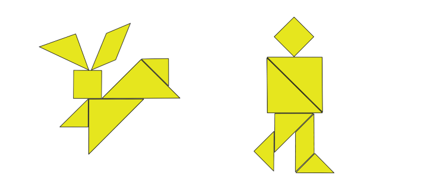
The boy has solved neither of these tangrams before.
“Choose wisely, Kai, and quickly. Your parents will be home soon.”
The tangram man’s voice rises to match the shrill wind which has accompanied the snowstorm. The room shakes, or else the boy is still shaking.
Was the front door always open? Light flurries, a thousand snowflakes like shards of mirrored glass begin to dance around the room. They are the most beautiful things the boy has ever seen. He fiddles with the buttons on his ill-textured shirt, contemplating the relief of taking it off.
All he must do is solve a puzzle. One last tangram and he’s free of the man that haunts it and of a world that doesn’t want him. All that’s left to do is twist the little yellow shards against the floor of the white, white room, and turn them into whatever he wishes to be.
He could be the man, yes, but even after he grows up, he’ll always have been the boy.
He remembers reading a story once about a pair of children in an icy country who left home, grew up, and returned to find that nothing had changed but them. Even if he could change, this is not a life he wants.
He wants, impossibly, parents that want him as he is now.
Man or rabbit. Rabbit or man.
The world and the people in it are sometimes kinder to rabbits than to men, he thinks. Less is expected of rabbits. No one has ever made a rabbit look them in the eye. No one has ever expected a rabbit to be something it can’t. But then the same problem as with becoming a man: once a rabbit, always a rabbit.
His hand hovers over the pieces, frozen in the moment of deciding.
___
Copyright 2026 Ichabod Cassius Kilroy
About the Author
Ichabod Cassius Kilroy
Ichabod Cassius Kilroy (called Ick by friends and haters alike) is a transsexual pile of mostly-real guts that could probably pass the Turing test, were the Turing test given to gutspills. It is a graduate of the 2023 Clarion workshop, enjoyer of coffee, and out of witticisms for this bio.